Natural Blue-Violet Tanzanite: Rarity & Custom Jewelry
- The violet‑blue tanzanite is the rarest variety of this gemstone, showcasing shades that range from deep blue to intense violet.
- Gold Shield crafts pieces with natural tanzanite set in solid 10k, 14k, or 18k gold, as well as .925 silver—fully certified and guaranteed karat.
- Our 3‑D design process lets you approve a render before production, ensuring the finished piece matches the concept exactly.
- Free, insured shipping is included throughout Mexico; for the USA, shipments are handled by Gold Shield LLC with payment in U.S. dollars.
- Fine gold and silver are hypoallergenic, and we offer custom engraving of names and dates.
What is natural blue-violet tanzanite and why is it so rare?
Blue-violet tanzanite is a specific variety of the gemstone, primarily mined in the Merelani Crater in Tanzania. This unique geological zone combines metamorphic rock formations with mineral veins rich in aluminum. Its rarity stems from the presence of iron and titanium in its crystal structure, which act as light filters to create a tone that ranges from the deep blue of a sapphire to the intense violet of iolite. According to the GIA (Gemological Institute of America), only 10% of mined tanzanite displays this specific hue. Of that 10%, a mere 2% reaches gem quality—meaning it has no visible inclusions to the naked eye, an optimal cut, and a color saturation exceeding 90% on the GIA color scale. This combination of restricted geographic origin, specific chemical composition, and strict quality standards makes blue-violet tanzanite one of the most sought-after gems among collectors, high-end jewelry designers, and fine jewelry enthusiasts looking for a truly exclusive piece.
Origin and gemological characteristics
Tanzanite belongs to the silicate group with a basic chemical formula of Na₂Al₃(AlSi₃O₁₀)(OH)₄. Its hardness on the Mohs scale ranges from 6.5 to 7, placing it just below topaz and above quartz. This makes it durable enough for daily-wear rings, though it remains sensitive to hard impacts. Its refractive index (RI) oscillates between 1.72 and 1.73, generating a characteristic vitreous luster and moderate dispersion that enhances color nuances under different light sources (natural, incandescent, or LED). The blue-violet variant contains traces of iron (Fe) and titanium (Ti) at concentrations of 0.1% to 0.3%, which modify the absorption of specific wavelengths. This creates a "color change" phenomenon, appearing as a cooler blue under fluorescent light and a warmer violet under incandescent light. Additionally, tanzanite exhibits notable birefringence, allowing gemologists to identify its origin through polarized microscopy.
How does blue-violet compare to other tanzanite varieties?
- Dark Blue: A cooler tone with less saturation, often showing a slight grayish cast in natural light.
- Violet: Higher saturation and brilliance, but often with a tendency toward fluorescence that can alter the color under UV light.
- Blue-Violet: The perfect balance between the two and the rarest variety. It combines the depth of blue with the warmth of violet, offering a play of colors that subtly shifts depending on the viewing angle and light source.

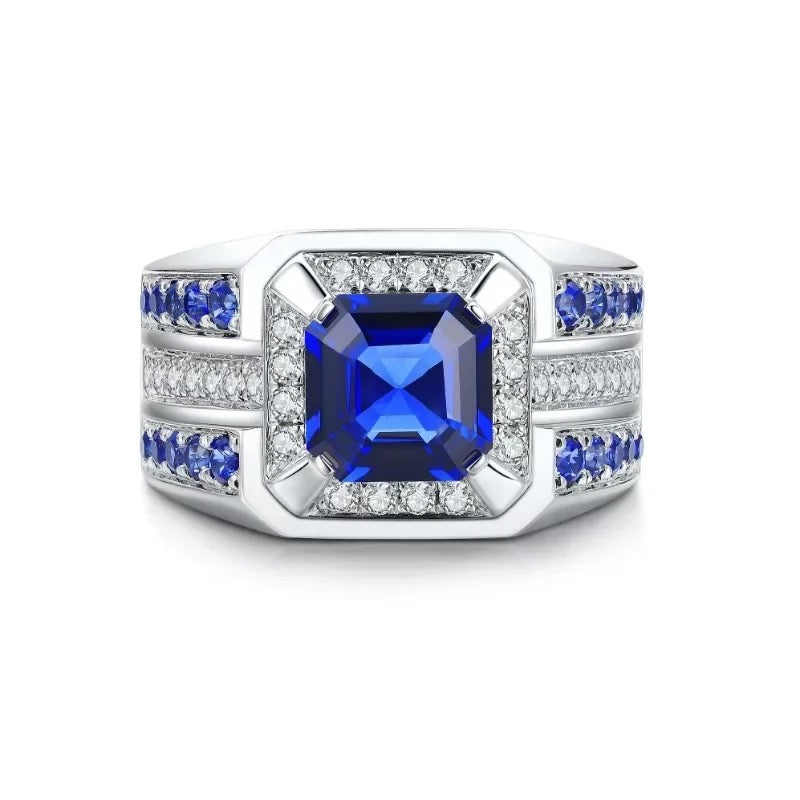
Tanzanita Azul Violeta Natural 1.27ct Corte Octágono Tanzania — Ver en Gold Shield →
What metals are used for Gold Shield’s blue‑violet tanzanite pieces?
At Gold Shield, every blue‑violet tanzanite piece is crafted from solid 10k, 14k, or 18k gold, and .925 silver. We carefully select each metal based on the customer’s taste, the type of piece (ring, pendant, earrings), and its intended use (daily wear vs. special events). Each metal undergoes alloying and polishing to ensure color consistency, corrosion resistance, and a flawless surface that won’t affect the gem’s hue. We also work with certified Mexican jewelers who use low‑temperature soldering and pressure setting to preserve the tanzanite’s integrity, preventing stresses that could cause fractures.
Is 10k, 14k, or 18k gold right for my tanzanite jewelry?
| Gold | Purity % | Durability | Approximate Price |
|---|---|---|---|
| 10k | 41.7% | Moderate; great for everyday pieces that need extra wear resistance. | $50-$80 |
| 14k | 58.5% | High; combines good mechanical strength with a warmer tone than 10k, ideal for rings and wedding bands. | $80-$120 |
| 18k | 75% | Very high; the higher gold content gives a richer color and greater malleability for intricate designs, though it’s slightly softer than 14k. | $120-$180 |
Why choose .925 silver for my tanzanite jewelry?
.925 silver (also known as sterling silver) consists of 92.5 % pure silver and 7.5 % copper or other metals that add hardness. It’s hypoallergenic, making it ideal for sensitive skin or nickel‑allergy sufferers. Its natural, bright white shine contrasts beautifully with blue‑violet tanzanite, enhancing the gem’s vibrancy. However, silver can tarnish over time, so we recommend regular microfiber polishing and gentle cleaning with mild soap and water. Storing pieces in anti‑tarnish bags keeps them looking new longer.
How do I pick the perfect natural blue‑violet tanzanite piece?
When you’re shopping for natural blue‑violet tanzanite, look at the stone’s size, cut shape, and the metal setting. Each of these factors changes how light plays inside the gem and how vivid the color appears. Our Mexican jewelry artisans have over 20 years of experience and are ready to guide you—whether you stop by a boutique or hop on a video call. We’ll tailor recommendations to your lifestyle, skin tone, and style preferences.
What size and shape should I choose?
- Round: classic and timeless; maximizes color symmetry and works well in engagement rings.
- Oval: elegant and flattering; elongates the hand and lets you carry more carat weight without a larger diameter.
- Square: modern and bold; a fancy cut highlights tanzanite’s birefringence, creating violet flashes at the edges.
- Emerald: rectangular with trimmed corners; perfect for pendants that need a flat surface for even light reflection.
- Octagonal: faceted cut that blends deep blue with vibrant violet for a multidirectional color view.
Which metal works best with blue‑violet tanzanite?
- 18k gold: luxurious and durable; its warm tone amplifies violet nuances—ideal for gala pieces or heirloom jewelry.
- 14k gold: a balance of cost and strength; a medium gold hue complements both blue and violet, great for everyday rings.
- 10k gold: budget‑friendly; a paler shade lets the tanzanite take center stage, perfect for light earrings and pendants.
- .925 silver: great for sensitive skin; the bright white shine enhances the gem’s clarity and gives a contemporary, minimalist look.
- Mixed metals (e.g., 14k rose gold with silver accents): create unique visual contrast that showcases the dual blue‑violet color.
What Drives the Price of Blue-Violet Tanzanite?
The price of a piece featuring blue-violet tanzanite isn't arbitrary; it’s built on a solid foundation of technical and artisanal quality. At Gold Shield, we believe every investment in fine jewelry must be justified by the intrinsic quality of the materials and the craftsmanship behind them. The final value of your piece depends on the synergy between the purity of the base metal, the excellence of the gem’s cut and clarity, and the level of customization that gives it a unique, one-of-a-kind character. By understanding these factors, you can see why two seemingly similar pieces might have significant value differences, ensuring that every ounce of gold or carat of tanzanite is backed by the highest standard of execution.
Metal Purity
Choosing the right metal is fundamental, as it defines not just the aesthetic but also the durability and resale value. As shown in the table above, purity increases value proportionally. 18-karat gold (750/1000) offers superior color intensity and significantly greater mechanical resistance than 10-karat gold (417/1000). In the context of tanzanite, whose blue-violet hue is delicate, the contrast with 18k yellow gold enhances the gem’s depth, while 18k white gold provides a neutral backdrop that intensifies the blue tone. The cost difference isn’t just a commercial margin; it reflects the higher precious metal content and the technical complexity required to work with purer alloys. These alloys demand strict control during casting and polishing to prevent deformation during daily wear.
Gem Cut and Quality
Tanzanite is a pleochroic gem, meaning its color shifts depending on the viewing angle. Therefore, the cut is about more than shape—it’s about optics. A 1.0 mm diameter tanzanite with optimal cuts designed to maximize light dispersion and reveal both the intense blue and deep violet will command a higher price than a 0.5 mm stone or one with imperfect cuts that dull its brilliance. Clarity is another critical factor: gems with minimal or invisible inclusions allow light to travel freely through their structure, creating that characteristic "fire." At Gold Shield, we select only stones with transparency that guarantees the blue-violet color is visible from any angle, avoiding stones that, despite their size, lack the chromatic vitality that defines high-grade tanzanite.
3D Custom Design
Customization goes beyond aesthetics; it’s a process of creative engineering that adds tangible value to the piece. Using 3D rendering technology allows you to visualize the jewelry before fabrication, correcting proportions and details that would be costly to modify once physical production begins. This process ensures the piece is unique, tailored exactly to the client’s hand measurements and aesthetic preferences. The added value here isn’t just for the design time, but for the guarantee that the final result will match your expectations 100%, eliminating uncertainty and the risk of error. Every hour spent in modeling software translates to millimetric precision in the wax or metal, ensuring that fine details, like prongs and edges, are perfect—something only possible with rigorous digital planning.

Ópalo Negro Natural Etiopía 1.12ct Corte Marquesa — View at Gold Shield →
Where Can I Buy Blue Violet Tanzanite Natural Rare Gems in the U.S.?
In a market flooded with generic jewelry, finding certified blue‑violet tanzanite is a challenge. Gold Shield is the online Mexican jewelry brand that hand‑crafts pieces featuring blue‑violet tanzanite, cutting out middlemen and providing a direct connection between the workshop and the customer. Our online store offers free shipping and factory‑direct prices, with guaranteed karatage, so you pay for real material quality and craftsmanship, not unnecessary distribution margins. Buying directly gives you detailed information on the gems’ origin and production processes, ensuring every piece meets the highest international jewelry standards tailored to U.S. consumer tastes.
Why Shop at Gold Shield?
- Free and insured shipping across the U.S.: Your investment is protected throughout the journey, with real‑time tracking so you always know exactly where your jewelry is, from our workshop to your doorstep, with no extra logistics fees.
- Custom 3D design: You approve the render before any metal is melted. This eliminates surprises and guarantees the piece looks exactly as you envisioned, with unlimited design adjustments.
- Certified natural gems: Every tanzanite we use comes from responsible mines and is backed by documentation proving its naturality and quality, protecting your investment and ensuring you’re not buying a counterfeit or undeclared treated stone.
- Hypoallergenic gold and silver: We use nickel‑free and heavy‑metal‑free alloys, ideal for sensitive skin. This is crucial for everyday jewelry, ensuring long‑term comfort and dermatological health—a detail many brands overlook.
How Does the Custom Jewelry Ordering Process Work?
The creation process at Gold Shield is designed to be transparent, collaborative, and efficient. It’s not a quick transaction but a guided design experience. The process is simple: choose a base piece, select the metal that best complements your style, customize the design in 3D with our interactive tool, approve the final render, and pay the factory‑direct price. This method ensures the customer has full control over the final result, reducing wait times and common misunderstandings in custom jewelry. Each step is documented and communicated, giving you confidence that your piece is in expert hands.
Step‑by‑Step Guide
- Visit the collection Blue Violet Tanzanite Natural Mexico – Unique Pieces: Browse our curated designs that highlight tanzanite’s optical properties, serving as a starting point for your creation.
- Select the piece and metal: Choose between yellow, white, or rose gold, and the desired karatage. Consider how the metal color will complement the blue‑violet stone for the contrast or harmony you seek.
- Access the 3D editor to personalize: Here your vision comes to life. Adjust shapes, add inscriptions, or modify secondary gem placement, seeing changes in real time.
- Submit the design for approval: Our team of jewelers reviews the technical feasibility and sends you a high‑resolution final render for final approval—no turning back after this point.
- Once approved, the jeweler fabricates the piece: The digital design is translated into wax or metal. An expert jeweler carves the gem, adjusts settings, and polishes every surface using artisanal techniques that ensure durability and shine.
- Receive your jewelry with free shipping: The piece is carefully packaged in our gift box and shipped to your address with full security, completing the creation cycle with the satisfaction of receiving a unique work of art.
How do I care for and maintain natural violet‑blue tanzanite?
Tanzanite is a relatively tough gemstone, rating 6.5‑7 on the Mohs scale, but it does need specific care to keep its sparkle and color over the years. Unlike emeralds, it isn’t extremely fragile, yet it can be affected by certain chemicals and impacts that may damage the surface. Proper maintenance not only preserves the jewelry’s look but also protects your investment. By understanding tanzanite’s nature, you can enjoy its beauty worry‑free, knowing how to handle it safely in everyday life.
What’s the best way to store tanzanite jewelry?
Keep the piece in a soft velvet or suede case, away from chemicals and other jewelry. Tanzanite, while harder than some stones in certain directions, is softer than sapphire or diamond and can be scratched if it contacts harder gems. Storing pieces separately also prevents prongs or edges from being damaged by friction. A dry, room‑temperature environment helps prevent metal alloy changes, ensuring the piece retains its structural integrity and original shine for decades.
How should I clean my violet‑blue tanzanite?
Use warm water and a mild soap, gently scrubbing with a very soft‑bristled brush to remove dirt from setting crevices. Avoid abrasive cleaners, harsh ultrasonic devices, or high‑heat steam, as they can harm the stone’s surface or loosen the setting. After cleaning, dry the jewelry with a clean microfiber cloth to prevent water spots. This simple routine, done every few weeks, restores tanzanite’s brilliance and removes residue from lotions or perfume that can dull its violet‑blue hue over time.
When should I have my tanzanite inspected?
Schedule an annual check‑up with a professional jeweler to confirm the stone is securely set and that there are no micro‑cracks in the setting. As a zircon‑silicate gem, tanzanite may contain natural inclusions that, under pressure, could become weak points. A jeweler can spot loose prongs before they lead to loss of the stone. The appointment also allows polishing of the metal and restoring its shine, keeping your piece looking like new. Don’t wait for visible damage—prevention is key to the longevity of your investment.

Zafiro Azul Verdoso Natural 0.98ct Corte Marquesa Tailandia — View on Gold Shield →
What are the most common mistakes people make when buying blue-violet tanzanite?
Buyers often slip up by settling for low-grade stones, choosing the wrong metal, or overlooking origin details. Purchasing tanzanite is an investment that demands knowledge, especially since the market is flooded with imitations and inferior stones that lack the aesthetic and financial value they promise. Avoiding these pitfalls ensures you acquire a piece that is not only beautiful but also a solid, lasting investment. Educating yourself is the best way to protect your investment and enjoy high-end jewelry without any unpleasant surprises.
Mistake 1: Skipping certification verification
Always verify that the gem is certified by a reputable international laboratory. Tanzanite is frequently heat-treated to enhance its color—a process that is acceptable if disclosed—but the certification must clearly state whether the stone is untreated or treated. A detailed certificate also confirms the absence of inclusions and verifies the exact weight. Without this document, you are buying blind, relying solely on the seller's word, which is risky in the high-end gem world. Always request the original certificate and verify its authenticity whenever possible.
Mistake 2: Ignoring metal purity
Metal purity affects both the durability and resale value of the piece. Low-purity metals, such as 10k gold or high-copper alloys, can oxidize, discolor, or cause allergic reactions over time. Additionally, the base metal value is a significant part of the total cost; choosing a higher karat not only improves the aesthetics but also protects the economic value of the jewelry. Do not underestimate the importance of the metal base; it supports the gem and must be worthy of the quality tanzanite it holds.
Mistake 3: Opting for generic designs
A generic design may not reflect your style or maximize the specific characteristics of the gem you have chosen. Each tanzanite has a unique color distribution; a standard design might fail to highlight its best attributes. By customizing, you can adjust the cut, setting, and details to emphasize the predominant blue or violet hue in your stone. Moreover, a custom piece carries superior emotional and rarity value, making it a more valuable collectible than mass-produced items available at any store.
What engraving and personalization options are available?
At Gold Shield, we understand that every piece of jewelry reflects the story and feelings of its wearer. That is why we offer engraving services for names, dates, or short messages on the noblest metals we handle, including both gold and silver. Engraving is permanent, ensuring the inscription remains impeccable for years, and it is hypoallergenic, making it ideal for sensitive skin or those seeking a piece free from irritation.
The engraving process
- Choose your text. You can select from a variety of fonts that suit the style of your jewelry, ranging from classic lettering to modern, minimalist styles.
- Laser engraving by our jeweler. We use high-precision laser technology to ensure every character is perfectly defined, without leaving marks or affecting the metal's structure.
- Design review. Before final production, you will receive a render of the engraving to confirm that the text and style meet your expectations.
When is the Best Time to Gift a Purple Blue Tanzanite Piece?
The purple blue tanzanite, with its deep and vibrant hue, becomes the perfect gift when you’re looking for something that blends elegance, meaning, and a touch of exclusivity. Below are some concrete occasions where its presence will make a difference:
- Anniversary Gift. A ring or bracelet with tanzanite symbolizes the strength and beauty of a relationship that has grown over time.
- Academic Achievement Celebration. A necklace or brooch with this gemstone celebrates dedication and success, reminding the importance of perseverance.
- Birthday Gift. Tanzanite adds a touch of luxury and sophistication to any birthday celebration, especially for those who appreciate craftsmanship and originality.
- Wedding Gift. In wedding bands or bride accessories, tanzanite adds a unique sparkle that complements eternal love.
- Corporate Award. A tanzanite piece can be a special recognition for standout employees, emphasizing the value of their effort and dedication.
How Does Purple Blue Tanzanite Compare to Other Purple Gemstones?
When it comes to purple gemstones, tanzanite stands out for its intense brilliance and color stability. In contrast, alexandrite is famous for its color change under different lights, making it more versatile but also more delicate in terms of sparkle. Below we dive into the key differences:
Compared to alexandrite, tanzanite has higher brilliance and less color change.
Quick Comparison
| Gemstone | Brilliance | Durability | Approximate Price |
|---|---|---|---|
| Purple Blue Tanzanite | High | 6.5-7 Mohs | $200-$400 |
| Alexandrite | Moderate | 6.5 Mohs | $250-$500 |
What Are the Benefits of Shopping at Gold Shield?
Choosing Gold Shield means you not only acquire a fine jewelry piece but also benefit from a set of advantages that ensure an exceptional experience:
- Factory Direct Pricing. By eliminating intermediaries, we offer competitive prices without compromising quality.
- Custom 3D Design. Each piece is modeled in 3D, allowing fine adjustments and preview before shipping.
- Free and Insured Shipping. Our shipping service covers costs and protects delivery with insurance.
- Certified Natural Gemstones. All stones come with official certification guaranteeing authenticity and origin.
- After-Sales Support. Our customer service team is available for inquiries and adjustments after purchase.
Real Testimonials
"The piece arrived perfect and the design was exactly what I imagined" - María G.
"The price was much lower than at a physical jewelry store" - Luis C.
"The engraving process was quick and the result was flawless. I recommend Gold Shield to anyone looking for quality and fair price." - Ana P.
Frequently Asked Questions
Is violet‑blue tanzanite safe for sensitive skin?
Yes. Gold Shield’s gold and silver are hypoallergenic and free of common allergens, ensuring comfort even on very sensitive skin.
What warranty do you provide?
We offer a carat‑weight guarantee and gemstone certification, plus a 2‑year warranty against any manufacturing defects.
Can I change the design after I approve the render?
No. Once the render is approved, the piece goes into production. You can request changes during the design phase before final approval.
How long does custom fabrication take?
Typically 7–10 business days, depending on design complexity and gemstone availability.
Do you ship to the United States?
Yes. Payments are accepted in USD through Gold Shield LLC. We offer express shipping with real‑time tracking.
How do I contact customer service?
WhatsApp: +1 845 622 6479.
Ready to create your one‑of‑a‑kind piece with natural blue‑violet tanzanite? Get a quote now via WhatsApp and experience the difference of handcrafted Mexican jewelry!